
Key Points in This Article:
- A striking number of cannabis licenses, especially those issued through social equity programs, never result in an actual operating business.
- In Maryland, only about 17 of 83 distributed social equity dispensary licenses, roughly 20 percent, were active as of mid-2026, even as a hard deadline approached.
- In Illinois, less than half of social equity cannabis licenses have become operational, with many expiring due to inactivity.
- Lack of capital is the most frequently cited reason licenses go unused, but it is rarely the only reason. Many license holders also lack a clear plan for how they will actually compete once they open.
- A license holder who treats branding, marketing, and business planning as part of the same process as licensing itself is in a far stronger position to actually launch, not just qualify to launch.
A License Is Not the Same Thing as a Business
Across the country, a consistent and sobering pattern has emerged. A meaningful share of cannabis business licenses, particularly those issued through social equity programs designed to create ownership opportunity, never turn into actual operating businesses. The license gets issued. The business never opens, or opens and closes shortly after.
In Maryland, reporting on the state’s social equity dispensary licenses found that as of mid-2026, only about 17 of the 83 distributed licenses, roughly 20 percent, had become active businesses, even as license holders approached a hard 24 month deadline to become operational or lose their license permanently. An earlier snapshot from late 2025 found the pace even slower, with only a handful of license types operational at all. Illinois tells a similar story. Less than half of the state’s social equity cannabis licenses have become operational, and many are at risk of expiring entirely due to inactivity, according to reporting on the program’s ongoing struggles.
These numbers matter well beyond the specific states where they were reported. They reflect something structural about the cannabis industry as a whole: receiving a license is a regulatory milestone, not evidence that a business is actually ready to compete and survive.
It Is Not Just About Capital, Though Capital Matters
The most frequently cited explanation for unused cannabis licenses is access to capital, and it is a real and significant barrier. Opening a compliant cannabis business typically requires substantial upfront investment, for construction, security systems, inventory, and licensing and compliance costs, and many license holders, particularly first time entrepreneurs, simply cannot secure that funding through traditional channels.
But capital alone does not fully explain the pattern. Even license holders who do secure funding often discover, only after the fact, that they lack a clear plan for how they will actually differentiate themselves and attract customers once they open. Capital gets a business built. It does not automatically make that business something customers choose over the competition already operating nearby. A location with no plan for brand identity, visibility, or ongoing marketing can burn through its startup capital quickly without ever building a sustainable customer base, which creates its own kind of failure, one that happens after launch rather than before it.
The Readiness Gap Hiding Behind the Capital Problem
Underneath the funding conversation sits a second, less discussed issue: many license holders enter the process having prepared extensively for licensing itself, but with little to no plan for what actually happens once the business is legally allowed to operate. This readiness gap tends to show up in a few recurring ways.
No answer to the differentiation question. In a market with a growing number of licensed operators, a new business needs a clear, compelling answer to why a customer should choose it specifically. License holders who have not worked through this before opening often find themselves competing purely on price, a difficult position to sustain long term.
No plan for visibility without paid advertising. Cannabis businesses cannot rely on the paid advertising channels most industries use to build early visibility, since major platforms restrict or prohibit cannabis promotion outright. Businesses that have not planned around organic visibility, local search, and content strategy in advance often spend their first months essentially invisible to the customers they need to reach.
Underestimating the cost and effort of staying visible. Branding and marketing are not expenses that end once a business opens. They require sustained investment, and license holders who treated marketing as a one-time, pre-opening task are frequently caught off guard by how much ongoing effort is required to stay competitive.
Entering predatory partnerships out of necessity. In some markets, license holders without a clear operational and growth plan of their own have ended up in management or financing arrangements that transferred most of the ownership and control they originally won through the licensing process. A clearer plan going in gives a license holder more leverage and more options when seeking outside support.
Building Readiness Alongside the Licensing Process
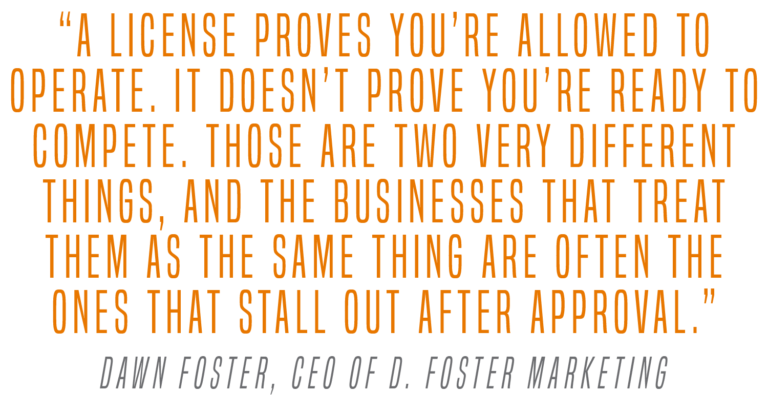
The license holders who do successfully launch and sustain their businesses tend to share a common pattern: they treated branding, marketing strategy, and competitive positioning as part of their preparation from the start, not as a project to begin after approval. This does not require waiting for capital to be fully secured or a license to be finalized. Brand identity, market positioning, and a realistic marketing plan can all be developed well before a business opens its doors, which means that by the time funding and licensing do come together, the business is not starting that work from zero.
This approach also strengthens a license holder’s position when seeking investment or negotiating a partnership. A business with a clear brand, a defined target customer, and a real marketing strategy presents a far more credible case to investors or lenders than one that has only completed the licensing paperwork.
Closing the Gap Between Licensing and Launch
If you are navigating the licensing process, or already hold a license and are evaluating what comes next, this is the moment to build the plan that determines whether your license becomes a thriving business or one more unused statistic. Our piece on why winning your cannabis license is not the finish line covers the broader pattern behind these numbers, and our guide to building a cannabis marketing strategy walks through what that planning should actually include.
A Partner Who Helps Close This Gap
At D. Foster Marketing, we work with cannabis entrepreneurs at every stage, including those trying to close the exact gap these numbers reveal. We help license holders and prospective operators build the brand identity, marketing strategy, and competitive positioning that turns a license into a real, lasting business. Learn more about our cannabis branding and marketing services.
Don’t let your license become part of next year’s inactivity statistics. Contact D. Foster Marketing today for a free planning conversation and let’s talk about what it will take to actually launch and sustain your business.
