
Key Takeaways:
Stop Marketing to Everyone: Niche down using long-tail keywords (e.g., “executive coaching for leadership”) to instantly signal expertise and attract high-value clients.
Your Website Must Sell: Treat your website as a 24/7 lead machine, not a digital brochure. Its primary job is conversion through clear CTAs and social proof.
The Fortune is in the Follow-Up: Use automated email sequences (powered by a high-value lead magnet) to build trust and qualify leads while you sleep.
Authority is the Ultimate Lead Magnet: Establish thought leadership via cornerstone content and podcast appearances to stop chasing clients and start attracting them.
Are you a coach, consultant, or therapist exhausted by the chaotic feast-or-famine cycle? Are you ready to make a strategic start to marketing in 2026?
You’ve likely invested in courses, posted endlessly on social media, and read every article on marketing for coaches and consultants. Yet, you still find yourself asking the frustrating question: “Why is my marketing not working?”
The truth is, marketing for a service-based business—where trust and expertise are the products—requires a specific, long-term strategy that blends proven digital marketing for coaches with genuine human connection. It’s not about quick fixes; it’s about building a predictable client acquisition system.
In this guide, I am spilling the secrets of successful coaches and consultants in digital marketing, and I will walk you through the top 10 best marketing strategies for coaches or consultants, leveraging both traditional SEO and new Generative Engine Optimization (GEO) principles. We’ll show you how to do marketing for coaching services or consultant services effectively, turning random acts of marketing into reliable revenue.

The Fix—Why Your Marketing Isn't Working
Before diving into the best marketing strategies for coaches, therapists, and consultants, you must address the core issues that sabotage your efforts. Most marketing fails for one of three reasons:
1. The Niche is Too Broad
You’re shouting into the void, trying to catch everyone. A “business coach” is forgettable; a “Scale-Up Strategist for SaaS Founders” is instantly relevant and attracts premium clients willing to pay for specific expertise. This broadness confuses both humans and algorithms, and we need both of those to find you online and connect with your services!
2. The Message is too “Me-Centric”
Your website and content talk about your certifications, your passion, and your process. But here’s the blunt truth: Clients don’t buy a process; they buy a transformation. If your marketing isn’t laser-focused on your client’s current pain and desired outcome, your message is missing the mark.
3. The Follow-Up System is Broken
Do you get leads but have no automated system to nurture them? Email marketing can yield an average $36 return for every $1 spent (Litmus, 2024), but that ROI disappears if you rely on sporadic, manual outreach. Trust takes time. Without a strategic email sequence, those valuable leads go cold, leaving you with zero conversions.
The Top 10 Best Marketing Strategies for Coaches and Consultants
1. Niche Down and Own Your Long-Tail Keyword
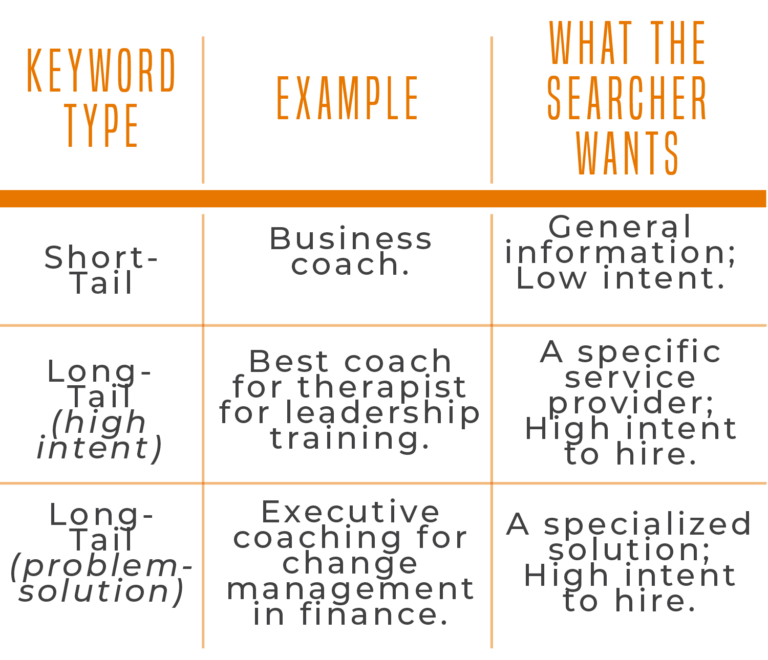
Forget trying to rank for a short-tail keyword like “Life Coach.” The competition is a bloodbath. Instead, focus on long-tail keywords—longer, more specific phrases that demonstrate high purchase intent.
2. Build a Conversion-Optimized Website (Your 24/7 Sales Asset)
Your website isn’t a passive brochure; it’s a machine designed to convert visitors into booked calls. A well-executed website design for consultants focuses on clarity, not creativity.
The 5-Second Test: A visitor must know who you help, how you help them, and what to do next within five seconds. If they don’t, they bounce.
Social Proof: Prominently feature video and written testimonials that emphasize the Before (pain point) and After (result).
Clear CTA: Use strong, benefit-driven calls-to-action (CTAs) like “Apply for the Program,” rather than generic “Contact Us.”
3. Implement the Signature Lead Magnet
This is the heart of your digital marketing for coaches strategy. A lead magnet trades a valuable, free asset for a prospect’s email address, transitioning them from a cold visitor to a warm lead.
Make it Specific: Don’t offer a generic e-book. Offer a hyper-specific tool, e.g., “The 3-Step Stress-Testing Checklist for Financial Advisors.”
Solve a Micro-Problem: It should give the client a quick, satisfying “win” that hints at the deep value of your paid service.
4. Master the Automated Email Nurture Sequence
Email remains the highest-ROI channel for revenue generation. Once a lead downloads your magnet, they need a dedicated, automated welcome sequence.
Sequence Goal: This email flow of five or six emails should introduce you, share your transformation story, provide more high-value tips, and share case studies for consultants.
The Invitation: The final emails gently invite them to book a discovery call. This system works while you deliver your services, making lead generation for coaches predictable.
5. Create High-Authority Cornerstone Content
To rank for broader, high-volume terms like “best life coaches for entrepreneurs,” you need deep, authoritative content.
Content Type: Write one definitive, 3,000+ word “cornerstone” guide on a core niche topic (e.g., The Ultimate Guide to Leadership Culture in Remote Teams).
Benefit: This in-depth content becomes the comprehensive source that both search engines (SEO) and generative engines (GEO) pull from, increasing the likelihood that you are cited as the expert answer and thought leader.
6. Focus on Thought Leadership on One Platform
Stop trying to master all social media platforms. Choose the one where your ideal client seeks professional information—for most US-based B2B consultants, this is LinkedIn.
Strategy: Consistently share unique insights, original frameworks, and deep dives into industry problems. Use video and long-form text posts to establish your expert authority and filter in premium leads.
7. Leverage the Power of Guest Podcasting and Webinars
This is one of the best marketing strategies for consultants because it allows you to “borrow” trust from an established authority. Appearing on just one relevant podcast can expose you to thousands of ideal listeners.
Targeting: Pitch yourself as a guest expert on podcasts or industry blogs that already serve your ideal client.
The Pitch: Pitch your unique solution to a problem their audience is struggling with. Always mention your free lead magnet (Strategy 3) to capture the listeners who convert later.
8. Use Video to Build Instant Trust
Video is crucial for service providers because it humanizes your brand and builds trust far faster than text alone, which is essential for a high-ticket sale. 84% of video marketers say video has directly increased sales.
Types: Use short-form video (Reels, TikTok, Shorts) for top-of-funnel visibility and awareness, and long-form video (YouTube, Webinars) to demonstrate your teaching style and expertise.
Authenticity Wins: Clients are looking for a personality they can trust. Focus on being genuine, not polished.
9. Price for Perception and Profit
If you’re asking, “Why is my marketing not working?” sometimes the problem is price, but not in the way you think. Low prices signal low value.
Strategy: Structure your services to sell the solution and the transformation, not your time. Use tiered pricing (Good/Better/Best) to anchor your premium offer.
Confidence: Marketing only works when you are confident in your value. Higher prices naturally repel clients who are not a good fit, improving your conversion rate with those who remain.
10. Commit to Consistent Measurement (and Stop Random Acts of Marketing)
If you can’t measure it, you can’t manage it. Many coaches and consultants quit their marketing strategies just before they pay off because they lack clear tracking.
Key Metrics (KPIs): Track Lead Magnet Opt-In Rate (a measure of your messaging), Email Click-Through Rate (a measure of engagement), and Discovery Call Show-Up Rate (a measure of lead quality).
The 90-Day Rule: Commit to any major strategy for a minimum of 90 days of consistent effort before making a final judgment on whether it’s working.
Stop Chasing, Start Attracting
The most effective marketing strategies for coaches and consultants are not about selling harder; they’re about filtering smarter and building authority deeper.
By implementing these 10 strategies—focusing on long-tail keywords, a conversion-optimized website, and automated follow-up—you move away from random, stressful chasing and install a predictable system that brings high-quality clients to you.
Stop asking “why is my marketing not working” and start using this playbook to build the consistent, scalable service business you deserve.
Ready to turn this playbook into a pipeline of qualified leads? Click Here to schedule a Strategy Session on How to Build Digital Marketing specifically for your niche.
Frequently Asked Questions (FAQs) for Marketing for Coaches & Consultants
Q1: What is the single most effective marketing strategy for coaches right now?
The most effective strategy is Niche Clarity combined with Long-Tail SEO. By defining a hyper-specific problem you solve (e.g., “Executive Coach for Remote Team Burnout”), you drastically reduce competition and attract the highest-intent clients searching for that exact solution.
Q2: Why isn’t my social media marketing working for my consulting business?
Social media marketing often fails because it lacks a clear conversion goal. If your posts don’t lead the viewer to a high-value asset (such as a lead magnet) that captures their email, you’re building an audience for the platform, not for your business. The focus should be on building a list, not chasing likes.
Q3: How often should I post content as a coach or consultant?
Consistency trumps volume. For thought leadership, aim for 2-3 high-value posts per week on your primary platform (e.g., LinkedIn). For cornerstone content (like blogs), focus on quality over quantity: one deep, 2,000+ word article per month is often more effective for long-term SEO and authority than four generic short posts.
Q4: Is email marketing still relevant for high-ticket coaching services?
Absolutely. Email marketing provides the highest ROI in digital marketing. It allows you to build the necessary trust over time through automated nurture sequences, which is crucial for a high-ticket, high-trust sale. An effective email sequence shares social proof and provides valuable context that converts cold leads into qualified discovery calls.
Dawn Foster is an unapologetic branding and marketing nerd who is passionate about research, analytics, and great storytelling through words and images. She is focused on helping business owners build and evolve their businesses with the right branding and marketing strategies and tactics. She has helped transform business owners into powerhouses through research, strategic planning, content development, education, and empowerment so that they can achieve success and reach their goals. As a business owner, her goal is to see others win, support her community, and do what she loves.
*Forbes Advisor. June 2024. https://www.forbes.com/advisor/business/software/website-statistics/
