
Key Takeaways From This Article:
- Healthcare is one of the most heavily regulated environments to market in, which makes it a useful benchmark for any business operating under compliance rules.
- Privacy rules like HIPAA shape what healthcare brands can track, collect, and share on their websites. Careful data handling is a habit that carries over to finance, real estate, and other industries with sensitive customer information.
- Federal regulators require health-related claims to be truthful and substantiated before they are published, which shows why a clear review process matters in every regulated field.
- Strong regulated-industry marketing does not mean less creativity. It means building trust through education, transparency, and consistency instead of bold promises.
- A marketing partner with healthcare experience brings a disciplined, compliance-aware approach that transfers across the other regulated industries a business may serve.
Why Healthcare Is the Benchmark for Regulated Marketing
Every industry that works under regulation faces some version of the same question: how do you grow a brand when the rules limit what you can say, show, and collect? Healthcare faces that question in its most demanding form. Patients are sharing sensitive information and making decisions that affect their health, and the laws that govern those relationships shape almost every marketing choice a practice makes.
That is exactly why healthcare marketing is worth studying, even for businesses that will never see a patient. The habits that keep a medical practice compliant, from careful website management to disciplined messaging to a real review process, are the same habits that protect a financial advisor, a real estate brokerage, or any brand in a regulated space. Healthcare marketers have been solving these problems for a long time, and their lessons transfer well.
Lesson One: Treat Data Privacy as a Marketing Decision
In healthcare, privacy is part of the marketing strategy. The way a website collects information, the tools running in the background, and the forms a visitor fills out can all create compliance exposure. The U.S. Department of Health and Human Services Office for Civil Rights has issued guidance on how HIPAA applies to online tracking technologies such as cookies and pixels, and it cautions that tracking tools can create privacy risk for healthcare organizations. A federal court later vacated part of that guidance as it applies to public webpages, but information on pages where users are logged in is still treated as protected under HIPAA, and other federal and state privacy laws may still apply. The practical lesson is that marketing tools should be chosen and reviewed with privacy in mind, not added by default.
This lesson reaches well beyond healthcare. Financial services firms and real estate brokerages also collect sensitive personal and financial information through their websites, forms, and email systems. Asking “what is this tool collecting, and where is that information going?” before adding any analytics or advertising tag is good practice in any industry where customers entrust you with private details.
Lesson Two: Claims Need Evidence Before They Go Live
Healthcare marketers learn quickly that what a brand says matters as much as how it says it. The Federal Trade Commission’s Health Products Compliance Guidance explains that claims about health benefits or safety generally require competent and reliable scientific evidence, and that this standard applies across advertising channels, including social media and digital content. Claims must be truthful and not misleading, and the evidence needs to exist before the message is published, not after someone questions it.
The same principle applies throughout regulated marketing. A financial brand cannot promise specific returns. A real estate brokerage has to avoid language that could suggest preference or discrimination. Every regulated industry has its own version of the claim that cannot be made without proof or without the right disclosures. Healthcare teaches a useful discipline: decide what you can support, say that clearly, and leave out what you cannot.
Lesson Three: Build Trust Through Education, Not Promises
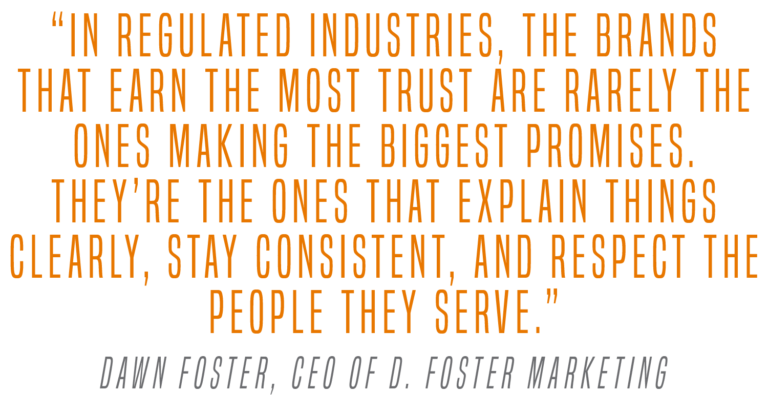
When a brand cannot promise outcomes, it has to earn trust another way. Healthcare marketing does this well through education. Practices explain conditions, describe what to expect from a visit, introduce their providers, and answer the questions patients are already searching for. That content builds credibility long before anyone books an appointment, and it stays comfortably within compliance boundaries because it informs instead of guaranteeing results.
Other regulated industries can use the same approach. A financial professional who explains how a type of planning works builds more trust than one who makes bold claims about performance. A brokerage that helps buyers understand the process earns confidence that a flashy listing alone cannot. Education supports organic search visibility too, which matters when paid advertising options are limited or heavily restricted.
Lesson Four: Build a Review Process Before You Need One
Medical practices that market well rarely rely on one person’s good judgment to catch every problem. They build a simple, repeatable process: who writes the content, who reviews it for compliance, what gets checked before it goes live, and how updates are handled over time. That process prevents expensive corrections, protects the practice’s reputation, and gives the team confidence to publish consistently instead of hesitating.
Any regulated organization benefits from the same structure. A short checklist covering claims, disclosures, privacy, and required language, applied to every page and post before publishing, catches most problems early. It also makes it easier to work with an outside marketing partner, because expectations are clear from the start.
Lesson Five: Consistency Is a Compliance Strategy
A brand that looks and sounds different from one channel to the next creates risk as well as confusion. Inconsistent messaging makes it harder to know which claims have been reviewed, which disclaimers are in place, and what the organization has actually promised. Healthcare practices with a clear brand voice, defined messaging, and documented brand guidelines find it easier to stay compliant because everyone works from the same approved foundation.
This is one reason strategy and branding belong together in regulated marketing. A strong brand system is more than a visual identity. It is a framework that helps a team communicate the same trustworthy message everywhere, including the website, social media, printed materials, and email.
How These Lessons Apply Across Regulated Industries
The details change from industry to industry, but the habits stay the same:
- Healthcare practices: protect patient privacy on the website, avoid unsupported outcome claims, and use educational content to build trust.
- Financial services: include required disclosures, avoid performance promises, and explain complex topics clearly so clients feel confident.
- Real estate: follow fair housing guidelines in every listing and message, and build credibility through local expertise and transparent communication.
- Emerging regulated industries such as cannabis: plan around advertising restrictions from the start and rely on organic visibility and compliant content to reach customers.
In each case, the organizations that grow steadily treat compliance as part of how they build the brand instead of a hurdle to clear at the end.
Why Experience Across Industries Matters in a Marketing Partner
A marketing partner who has worked in healthcare brings an approach shaped by one of the strictest environments there is. That discipline, careful about privacy, rigorous about claims, and consistent about process, makes the work stronger for every other regulated client as well. It also means fewer surprises, because the team has already learned where the problems tend to appear.
At D. Foster Marketing, our team brings more than 60 years of combined experience across branding, strategy, web design, and organic digital marketing, with deep experience supporting healthcare practices and financial and real estate professionals. If you want a broader look at how marketing changes by industry, our guide to effective and compliant marketing in highly regulated industries is a good next read, and our piece on building a marketing engine for your regulated business shows how these pieces fit together. You can also explore our full range of branding and marketing services.
Ready to work with a marketing partner who understands the demands of regulated industries? Contact D. Foster Marketing today for a free clarity call and let’s talk about what compliant, trust-building marketing could look like for your organization.
